

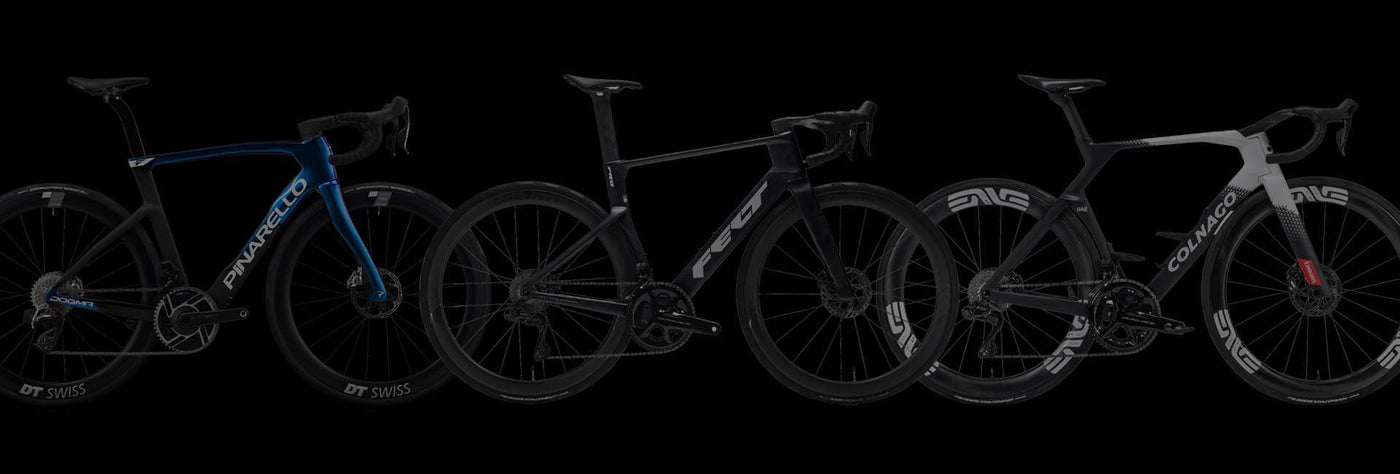
The question used to be simple. Aero bikes were for flat roads and sprints. Lightweight bikes were for mountains. Endurance bikes were for people who wanted comfort over speed. Three categories, three distinct purposes, three clearly different bikes.
That clarity is gone. The lines between these categories have blurred to the point where the labels themselves are becoming less useful — and understanding why that is happening matters more than memorizing which bike belongs in which box. If you are shopping for a road bike right now, the real question is not which category to pick. It is which combination of traits matches how you actually ride.
Here is how we think about it at RA Cycles after fitting and selling thousands of road bikes across every category.
The Aero Bike Moment
There is no getting around it: aero is the dominant force in road cycling right now. Walk into any shop, scroll any cycling forum, look at what the pros are racing on most days of the year — aero bikes are everywhere, and for good reason.
Part of it is performance. Aerodynamic drag is the single biggest force working against you on flat and rolling terrain, which is most of the riding most people do. At 30 km/h, roughly 80 percent of your energy goes to overcoming air resistance. An aero frame, integrated cockpit, and optimized tube shapes can save meaningful watts — the kind of savings you actually feel over the course of a ride, not just on a spreadsheet.
But part of it is something else entirely. Aero bikes look fast. They have presence. The deep tube profiles, the integrated bars, the aggressive stance — there is an ambition to the aesthetic that draws people in. When you see a Pinarello Dogma F or a Colnago Y1Rs or a Scott Foil RC leaning against a cafe wall, it turns heads. That visual impact matters. We talked about this in our road bike buyers guide — if a bike excites you every time you look at it, you ride it more. Aero bikes, by design, deliver that excitement.
The current generation of aero bikes from our catalog makes the case even more compelling. The Wilier Filante SLR ID2 has pushed its frame weight down to 870 grams while maintaining full aero optimization — numbers that would have been considered climbing bike territory just a few years ago. The Bianchi Oltre RC borrows aerodynamic thinking from Formula 1 with its Air Deflector technology. The Look 795 Blade RS combines French engineering precision with one of the slipperiest profiles in the peloton. The Felt NEXAR FRD delivers wind-tunnel-validated performance at a more accessible price point. And the ENVE Melee, built by a company that made its name in aerodynamic carbon wheels, brings that same obsessive focus to a complete bike platform.
The aero category has never been this deep or this diverse, and it is only getting more interesting.

Why Aero is Winning the Category War
Here is what is really happening beneath the surface: aero bikes are not just getting faster. They are getting lighter, more comfortable, and more versatile — which means they are absorbing the traits that used to belong exclusively to other categories.
The Colnago Y1Rs is a perfect example. It reduces frontal area by 19 percent compared to the V4Rs that preceded it, yet the frame weighs around 790 grams. That is lighter than many dedicated climbing bikes from five years ago. Pinarello's Dogma F achieves a similar trick — an 865-gram frame that performs in the wind tunnel but also climbs with the best pure lightweight bikes in the world. Scott's Foil RC, once a pure aero machine, now comes with tire clearance up to 30mm and ride quality that would have been unthinkable in an aero frame a generation ago.
This convergence is not accidental. Engineers have gotten better at shaping tubes that cut through the wind without needing the deep, heavy profiles of older aero designs. Carbon fiber layup technology has advanced to the point where stiffness, low weight, and aerodynamic shaping are no longer competing priorities. The result is a new generation of aero bikes that can genuinely do everything — sprint, climb, descend, and ride all day without beating you up.
For the average cyclist who does a mix of flat riding, rolling hills, group rides, and the occasional event, an aero bike in 2026 is arguably the most versatile choice you can make.

The Endurance Bike: Evolving From Both Directions
Endurance bikes occupy a fascinating position in the market. On one hand, they have always been about comfort — longer wheelbases, taller stacks, more tire clearance, frame designs that absorb road vibration. On the other hand, the latest endurance bikes have quietly become remarkably fast.
The Wilier Granturismo SLR is the clearest example in our range. It looks and feels like a premium race bike, but the geometry puts you in a position that you can hold for five or six hours without your back and neck paying the price. The Pinarello Dogma X does the same thing at the flagship level — taking the engineering DNA of the Dogma F race bike and tuning the geometry and compliance for riders who value long-distance comfort alongside outright performance. The ENVE Fray applies the same philosophy, pairing a race-bred carbon platform with geometry that favors endurance riding and mixed-surface versatility.
But here is the point that deserves more attention: the influence is flowing in the other direction too. Many of the newest race bikes — bikes that are categorized and marketed as race machines — are quietly adopting endurance-friendly characteristics. Stack heights are creeping up. Tire clearance is expanding. Frame compliance is being engineered in rather than designed out. More and more cyclists want to do long distance riding on their race bikes, and the manufacturers are listening.
The Pinarello F-series is a good illustration. The F7 and F9 sit between the Dogma F and the Dogma X in terms of geometry — they are race bikes in every meaningful sense, but with enough compliance and position flexibility that a century ride is not a punishment. The Van Rysel RCR Pro has geometry that straddles the line between race and endurance in a way that would have been unusual even three years ago. The Scott Addict RC, traditionally positioned as a pure climbing race bike, now comes with clearance for 34mm tires — a number that used to be exclusive to endurance and gravel territory.
The takeaway is this: if you are drawn to endurance bikes because you want comfort on longer rides, it is worth looking at modern race bikes as well. The gap between the two categories is narrower than it has ever been, and you may find that a race bike with slightly relaxed geometry gives you the comfort you need without any of the compromises you were expecting.

Lightweight: A Category That is Disappearing Into Everything Else
This is where the conversation gets particularly interesting. The dedicated lightweight climbing bike — the category defined by sub-800-gram frames, minimal tube profiles, and a singular focus on the scales — is a shrinking segment. Not because climbing bikes have gotten worse, but because everything else has gotten lighter.
When a Colnago Y1Rs aero frame weighs 790 grams, and a Wilier Filante SLR ID2 aero frame hits 870 grams, and a Pinarello Dogma F comes in at 865 grams, the question becomes: why buy a dedicated climbing bike when the aero bike climbs nearly as well and is significantly faster everywhere else?
The answer, for some riders, is still the ride quality. A true lightweight climbing frame — the Colnago V5Rs, the Scott Addict RC, the Wilier Verticale SLR, the Bianchi Specialissima RC, the Look 786 Huez 2 — has a character that is difficult to replicate. These bikes are responsive in a way that heavier frames simply are not. Out-of-the-saddle efforts feel snappier. Direction changes on switchback descents feel more intuitive. There is a liveliness to a sub-700-gram frame that has nothing to do with the number on the scale and everything to do with how the bike communicates with the road beneath you.
But the category is evolving from within, too. Look at the Scott Addict RC: the frame weighs 599 grams in HMX-SL carbon, making it one of the lightest production frames ever built. But the latest generation also incorporates aero elements — a narrower head tube, a subtly shaped downtube, refined seatstays — that make it nearly as aerodynamic as the previous generation Foil. Scott's own testing shows the new Addict RC is only 9 watts slower than the current Foil RC at 45 km/h. That gap used to be 25 or 30 watts.
The reverse is equally true. Aero bikes with sub-1000-gram frames and large tube profiles are increasingly being described as lightweight. When your aero bike weighs 6.8 kg built, it is a lightweight bike in every practical sense — it just happens to also be aerodynamic.
For riders who live in the mountains, who measure their rides in vertical meters gained, or who simply love the feeling of a feather-light bike dancing up a grade, the dedicated climbing category still makes sense. The Wilier Verticale SLR, the Colnago V5Rs, and the Bianchi Specialissima RC are extraordinary machines that do something no aero bike can fully replicate, no matter how light it gets. But for everyone else, the pure lightweight category is becoming a niche rather than a necessity.

So Which One Do You Buy?
The honest answer depends on how you ride and what you value. But here is a framework we use at RA Cycles when helping riders make this decision.
If most of your riding is on flat to rolling terrain, if you ride in groups, if you care about speed and efficiency over the widest range of conditions, if the aggressive aesthetic of a modern aero bike speaks to you — go aero. The Pinarello Dogma F, Colnago Y1Rs, Scott Foil RC, Wilier Filante SLR ID2, Bianchi Oltre RC, ENVE Melee, Look 795 Blade RS, Felt NEXAR FRD, and Van Rysel RCR-F Pro are all outstanding options at different price points, and every one of them climbs far better than any aero bike had a right to just a few years ago.
If your priority is riding long distances in comfort, if you deal with rough roads, if you want a bike that feels good at hour five the same way it feels at minute five — look at the endurance category. The Pinarello Dogma X, Wilier Granturismo SLR, and ENVE Fray are bikes that prove comfort and performance are no longer at odds. But also consider the latest race bikes with endurance-friendly geometry — the gap may surprise you.
If you live in the mountains and climbing is the core of your riding identity, a dedicated lightweight bike still delivers something special. The Colnago V5Rs, Scott Addict RC, Wilier Verticale SLR, Bianchi Specialissima RC, and Look 786 Huez 2 offer a riding experience that no amount of weight reduction in an aero frame can fully match. Just know that the performance gap on the flats is real, and if your riding is mixed, an aero bike that happens to be light may serve you better overall.

The Lines Keep Blurring — And That is a Good Thing
The convergence between these categories is not a marketing gimmick. It is the natural result of better engineering, better materials, and a more honest understanding of how people actually ride. Most cyclists do not need a pure aero bike, or a pure climbing bike, or a pure endurance bike. They need a bike that does many things well, fits their body, matches their riding style, and — as always — makes them want to get out the door.
The fact that a modern aero bike can weigh under 7 kg, that a climbing bike can be nearly as aerodynamic as last year's aero machine, that an endurance bike can keep pace with a race bike on a fast group ride — this is the best time to buy a road bike, because every category is better than it has ever been.
At RA Cycles, we carry the full range — aero, lightweight, endurance, and everything in between — from Pinarello, Colnago, Scott, Cervelo, Van Rysel, TIME, 3T, Wilier, Bianchi, ENVE, Felt, and Look. We also build custom bikes for riders who want to pick and choose from the best of every category. Come talk to us. We will help you figure out which combination of traits is right for your riding, your body, and the roads you call home.
