

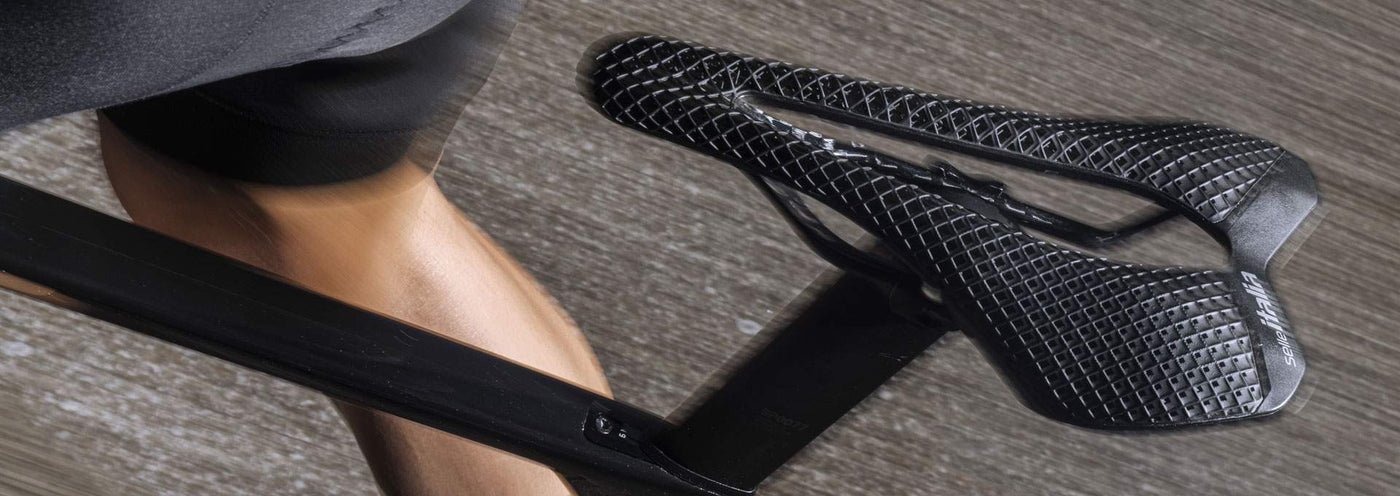
There is no piece of cycling equipment more personal than a saddle. Wheels, frames, and components have measurable performance characteristics you can compare on paper. A saddle is different. The same saddle that wins grand tours will ruin a perfectly capable rider's enthusiasm for the sport if it doesn't match their anatomy, position, and riding style.
The good news: finding the right saddle is learnable. The less good news: it takes patience, some trial and error, and a willingness to question things you might assume are the saddle's fault — when they often aren't.
This guide covers everything you need to narrow the search — starting with the most commonly overlooked causes of saddle discomfort, and ending with a clear framework for making a smart selection.

It's Often Not the Saddle
Before spending $150–$400 on a new saddle, consider two factors that cause far more saddle discomfort than the saddle itself.
Bike Fit
Saddle discomfort is frequently a bike fit problem in disguise. A saddle that's too high creates excessive rocking through the hips, increasing pressure and friction with every pedal stroke. Too low and the rider sits more upright, shifting weight onto soft tissue rather than sit bones. Too far forward or back changes where you contact the saddle and how much weight ends up on your hands versus your pelvis.
The handlebar position matters too. A bar that's too low or too far away places excessive weight on the front of the pelvis — not the seat bones — leading to numbness and pain that no saddle shape or padding level will fix. This is a geometry problem, not an equipment problem.
If your saddle discomfort is persistent and you haven't had a professional bike fit, that is the first thing to address. A fitting session — including our digital fitting consultation for remote customers at racycles.com/pages/bike-fit — will tell you more about your saddle needs than any amount of swapping saddles on a poorly positioned bike.
Bib Shorts
A worn-out or poorly padded chamois creates friction and pressure independently of the saddle beneath it. Cycling chamois — like tires — have a useful life. A chamois that's been washed 150 times has compacted foam that no longer does its job. You might be blaming the saddle for discomfort that started six months ago when your bibs aged out.
If you're in the market for a saddle, it's worth evaluating your bibs at the same time. We've written a complete guide to cycling bib shorts organized by riding style and brand at The Complete Bib Shorts Guide. Solving the bib problem first makes it considerably easier to evaluate whether a new saddle is actually needed.

Start With Sit Bone Width
Your sit bones — the ischial tuberosities — are the two bony protrusions at the base of your pelvis. They are the points that should be making contact with the saddle when you're riding at an efficient, forward-leaning position. The distance between them is the single most useful measurement in saddle selection.
Sit bone width doesn't translate directly to saddle width in a 1:1 ratio, but wider sit bones generally require a wider saddle. Most manufacturers add 20–30mm to the measured sit bone distance to determine optimal saddle width. A rider measuring 130mm between sit bones typically fits a saddle in the 150–155mm width range.
How to measure: The most reliable method is a sit bone measurement from a professional fitting session or a shop with appropriate tools. A DIY version — sitting on a piece of memory foam and measuring the indentations — gets you in the right range, though it isn't as precise as a dedicated device.
What sit bone width doesn't tell you: Flexibility and riding position affect saddle choice considerably. A rider in a steep, aero position rotates their pelvis forward, shifting weight toward softer tissue. Two riders with identical sit bone widths can need very different saddles because their pelvic rotation is completely different.

Shape, Profile, and the Decisions That Actually Matter
Flat vs. Curved Profile
A flat saddle gives the rider more freedom to shift position — slide forward on climbs, move back for descents, vary the contact point throughout a long ride. Racing cyclists tend to prefer flatter profiles. A curved saddle cradles the rider more firmly in one position, common in saddles designed for relaxed geometry bikes.
Central Channel
A channel running along the centerline of the saddle reduces pressure on the perineal area. Numbness is not something to push through — it indicates restricted blood flow. A center channel, combined with correct fit, is the most reliable structural fix. Channel depth and width vary significantly by model; some are subtle, others (particularly Selle SMP) are dramatically pronounced.
Noseless Saddles
ISM pioneered the noseless saddle for time trial and triathlon, where riders in an aero position sustain significant perineal pressure on a traditional nose. ISM saddles relocate the sit bone contact points forward and eliminate the nose entirely. If you ride with aerobars for any meaningful portion of your riding, an ISM saddle is worth a serious trial.
Padding Density
Counterintuitively, a heavily padded saddle is not always more comfortable. Soft foam compresses under pressure, forcing sit bones downward and creating friction in exactly the wrong places. Firm padding maintains its shape, supporting the sit bones consistently. For rides under 90 minutes, cushioning is often fine. For 3–6+ hour days, a firmer saddle typically results in less discomfort over time.
Rail Material
Rails come in steel, aluminum, titanium, and carbon. Carbon rails are lightest and provide some vibration damping, but they require specific seatpost clamps and don't tolerate aggressive torqueing. Titanium is the durability and weight sweet spot for most riders. Steel rails are heaviest but virtually indestructible.
The Saddle Shell
Beneath the padding and cover sits the shell — the structural foundation everything else is built on. Most performance saddles use a carbon fiber shell: stiff, light, and capable of being engineered with specific flex profiles to absorb some road vibration without adding weight. A stiffer shell transfers more power; a more compliant one takes the edge off rough roads.
Entry and mid-range saddles typically use a composite or reinforced nylon shell, which is heavier but more forgiving underload and considerably more durable in the event of a crash. The shell is what you don't notice when the saddle is right — and what you immediately notice when it isn't.
What the Saddle Is Made Of: Upper Materials
The surface material — what your shorts actually contact — affects comfort, grip, durability, and weight in ways that go beyond the obvious.
Synthetic / Faux Leather
The most common cover in mid-range and performance saddles. Durable, easy to clean, weather resistant, and consistent across production runs. It doesn't mold to your anatomy the way leather does, but it requires no break-in time and holds up well through years of use. The majority of saddles in the Fizik, Selle Italia, and Form Cycling range use high-quality synthetic covers.
Leather
Traditional leather saddles mold to the rider's anatomy over hundreds of hours of use, eventually producing a contact surface genuinely custom-shaped to that individual. The tradeoff is weight, maintenance, and a break-in period measured in weeks or months. Leather saddles are a long-game investment for riders who prioritize ultimate personalized comfort — typically on upright or randonneuring setups — rather than a performance choice.
Carbon Fiber Top
Some ultralight race saddles use a carbon fiber surface — firm, minimal, and as light as the technology allows. There is effectively no padding. The assumption is that at the weight and position where these saddles make sense, the rider's high-quality bibs are doing the comfort work, and the saddle's job is to provide a stable reference point. Not for everyday riding.
3D Printed Lattice
This is where the category is going, and for good reason. Instead of foam cut to a fixed density, 3D printed saddles use a lattice structure — a complex web of elastomeric or resin material — where the density can be varied zone by zone across the saddle surface. The result is a saddle that can be firmer under the sit bones, softer at the nose, and precisely tuned at every contact point in a way that a single foam block simply cannot replicate.
The early versions were expensive outliers at the top of the market. They now appear at multiple price points across major brands, and the performance advantage — particularly on longer rides and rougher roads — is genuine enough that 3D printed construction is on track to become the standard rather than the exception. If you're replacing a saddle now and plan to keep it for several years, it's worth evaluating 3D printed options before deciding. The technology is conforming to riders in ways that traditional foam never could.
The Brands We Carry
RA Cycles stocks saddles from five brands, each with a distinct engineering philosophy.
Fizik
Fizik's line is organized around the Spine Concept and the Adaptive sizing system. The Spine Concept classifies riders by spinal flexibility: Bull (limited flexibility, curved saddle), Chameleon (average flexibility), or Snake (very flexible, flat profile). The Adaptive system offers multiple widths within the same model, matched to sit bone width rather than a generic S/M/L.
The Vento Antares is the benchmark road racing saddle — flat profile, minimal padding, for riders in aggressive positions. The Argo line introduced a shorter nose format with medium curvature, suited to riders with moderate flexibility. Fizik also offers 3D printed Adaptive variants with zone-specific lattice density, built using Carbon DLS technology — a meaningful upgrade for riders who've found the standard foam version close but not quite right.
Form Cycling
Form Cycling was designed from the ground up by bike fitters — people whose job is diagnosing comfort problems on the bike every day. That perspective is evident in the Throne line, which is focused in its intent rather than broad in its lineup.
The range covers four models. The Throne RS is built for aggressive to moderate road positioning, with a full-length center channel and 150mm width that suits a wide range of riders. The Throne RS2 refines the RS geometry with updated proportions. The Throne GT (gran turismo) targets long-day endurance riding at a more upright position. The Throne Aero uses a short-nose design specifically for triathlon and time trial, supporting forward hip rotation in an aero position.
All four models are available with titanium rails ($185) or carbon rails ($275). For a brand founded on fit principles rather than marketing, the value proposition is strong — these saddles exist because the people who designed them spend their professional lives solving exactly the problems they're built to address.
ISM
ISM's entire range is built around the noseless design. The PN series is the benchmark for triathlon and time trial. The PR series targets flat-position road and gravel riding. The Metro is a shorter option for slightly more upright positions. Riders who persist through the adjustment period from a traditional saddle are almost universally glad they did.
Selle Italia
Selle Italia has one of the most clearly structured model hierarchies in cycling saddles. Understanding their naming system saves significant confusion at the point of selection.
Three core shapes define the line. The Flite is the flat-profile classic that's been in the range since the 1990s — maximum freedom of movement, suited to riders who shift position frequently. The SLR is the neutral-profile road saddle that supports pelvic rotation; it's the most versatile shape in the range for road cyclists in a moderate to aggressive position, with the Kit Carbonio at the top using a 30% carbon composite shell and CarboKeramic oval rails. The Novus uses a wave-shaped profile with additional rear structure, suited to riders with posterior pelvic tilt who need more support under the sit bones.
BOOST designates a shorter nose — the Boost version runs approximately 248mm in length versus the standard 275–282mm. This is not a cosmetic difference. A shorter nose reduces contact pressure for riders who carry weight forward of the sit bones, and improves clearance in very aero positions. If you've found Selle Italia saddles comfortable but feel pressure at the front on long rides, the Boost version is the logical next trial.
Superflow refers to the extended central cutout — a relief channel that runs the length of the saddle for maximum soft tissue pressure reduction. Many Selle Italia models are available in both standard and Superflow configurations, which makes it possible to address soft tissue pressure without changing the underlying saddle shape.
Selle SMP
Selle SMP takes a different path from every other brand on this list. Their saddles feature a dramatically curved spine, an oversized central channel that removes virtually all central pressure, and a design that positions the sit bones further back than conventional saddles. For riders who connect with it, the result is a saddle that works with the body's movement rather than constraining it. The Pro, VT30C, and Evolution are the most common starting points. Setup requires more attention than a conventional saddle — the nose typically points slightly downward from what most riders expect — but once dialed in, the SMP design has a devoted following for good reason.
The Reality of Saddle Selection
Here is the honest version of how saddle buying actually works, in our experience at RA Cycles over 50 years in business:
Sometimes you get lucky. You sit on a saddle, take it for a few rides, and never think about it again. This is the exception, not the rule.
More often, there's a break-in process — both for the saddle and for your body's adaptation to it. Foam compresses and shapes over the first 10–20 hours of use. Your position stabilizes. A saddle that felt questionable at 45 minutes might feel excellent at 3 hours once everything has settled. Don't judge a saddle by its first two rides.
The more confusing scenario: a saddle that works perfectly for months, then develops a problem. This usually traces back to one of three things — your position shifted (new seatpost, new bike, or gradual fit drift), the saddle's foam compressed past a useful threshold, or your bib shorts aged out and the combination that was working stopped working. Eliminate those variables before concluding the saddle itself is wrong.
And when you do find the right saddle: buy multiples. Saddle models get discontinued, production specifications can shift between runs, and the saddle that works for you is worth having two or three of. Buy them on the same production run — same batch, same materials, same foam density. This is advice we've given thousands of riders over the years. The ones who listen rarely regret it.
Finding Your Saddle at RA Cycles
Start with a sit bone measurement — we can do this at the shop and point you toward the right width range across our full saddle inventory.
From there, the questions that matter most:
- What is your riding position — upright, moderate, or aggressive and aero?
- What disciplines do you ride — road, gravel, triathlon, or some combination?
- Do you experience numbness, or is the discomfort pressure-based on the sit bones?
- What is your typical ride duration?
Each answer points toward a different part of the range. Numbness on a conventional saddle points toward ISM or a deep-channel option. An aggressive road position points toward the Fizik Vento Antares or Form Cycling Throne RS. Long endurance days at a moderate position point toward Selle Italia Novus, Selle SMP, or the Form Cycling Throne GT. Triathlon with aerobars — ISM or Form Cycling Throne Aero.
The right saddle exists for you. Finding it takes a good measurement, some patience, and occasionally a willingness to try something that looks unconventional. Once you find it, everything about your riding gets easier.
