

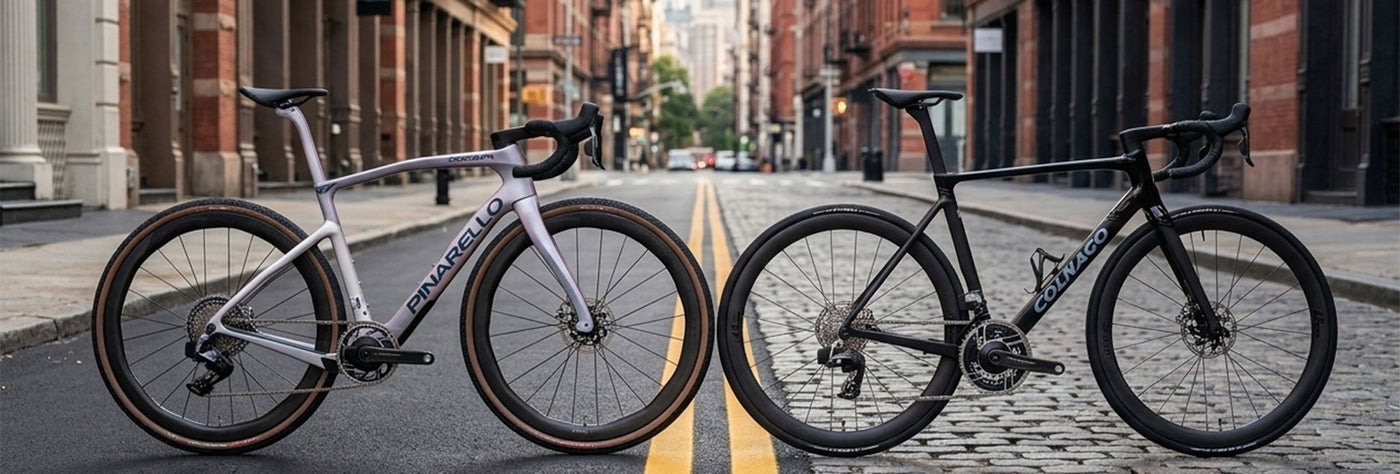
Every week someone walks into one of our shops — Brooklyn, Walnut Creek, or Miami — and asks the same question. They already ride. They want the next bike. And they cannot decide: road or gravel.
It is a real question, and it deserves a real answer. Both bikes look similar from ten feet away. Drop bars, skinny-ish tires, carbon or steel, one or two chainrings up front. But the ride each one gives you is very different, and the life each one fits into is very different too. The honest truth is that most serious riders we know eventually end up with both in the stable. If your budget only allows one right now, that is fine — we will help you figure out which one earns the spot.
This is not a spec-sheet war. This is a guide to picking the bike that matches the way you actually want to ride.
What Each Bike Is Built To Do
A modern road bike is a purpose-built machine for speed on pavement. Stiff, light, aerodynamic, geared for maintaining a fast steady cadence on sealed roads. Tire clearance usually tops out around 30 to 35mm. Geometry is tuned for responsiveness — a twitch of the hips and the bike moves. The road bikes we carry include the Pinarello Dogma F, the Colnago Y1Rs and V5Rs, the Cervélo S5 and R5, the Bianchi Oltre RC and Specialissima, BMC, Scott, 3T, Cannondale, and Wilier. Different flavors — aero, lightweight, endurance — but all built around the same idea: efficient, controlled speed on pavement.
A gravel bike is a different animal. It is a drop-bar bike designed to be happy on surfaces that a road bike is not. Wider tire clearance — 43mm to 66mm depending on the frame — longer wheelbase, slacker head angle, lower bottom bracket in most cases, more compliant frames, wider gearing range. The gravel bikes at RA Cycles include the Pinarello Grevil F, the OPEN U.P. and WI.DE., the Cervélo Áspero and Áspero-5, the 3T Exploro RaceMax, the BMC Kaius and URS, the ENVE MOG, and the Wilier Rave SLR. Every one of these bikes will carry you comfortably on pavement. None of them are as fast on a smooth road as a proper road bike. In exchange, they will go almost anywhere.
That tradeoff is the whole conversation.
The City Factor
Living in Brooklyn, I can tell you exactly what New York City roads are like. They are bad. Potholes deep enough to lose a tire in, patches on top of patches, sewer grates that are never quite flush, and construction plating that changes orientation every week. The Bay Area has its own version of this — Walnut Creek and beyond, with weather-beaten chip seal and broken shoulders. Miami has pavement that expands and cracks in the heat. In any real city, the shortest distance between two points is not a clean line.
This is where a lot of riders are quietly switching to gravel as their everyday drop-bar bike. A gravel bike on 38 to 45mm tires absorbs urban chaos in a way that a road bike on 28s simply cannot. You can hop a curb to get around a double-parked truck. You can cut through a park path on the way home. You can take a rougher route and not think twice about it. The bike becomes a tool for the city you actually ride in, not the city you wish you rode in.
A road bike is still fine in the city if you know the routes and you are comfortable on narrower rubber. But if you are commuting through the five boroughs, or riding from Oakland up into the hills, or cutting across Miami on roads that change every block, the extra tire and extra compliance of a gravel bike pays for itself within a week.
Group Rides And The Camaraderie Of The Road
Here is the thing nobody says out loud enough: road cycling is social. Saturday morning group rides, club rides, paceline work, centuries, fondos, racing — all of it is built around road bikes on pavement. If you want to ride with people, go the distance, sit in a rotation, and feel that rhythm of 15 or 20 bikes clicking through a corner together — you want a road bike.
Me personally, when I am riding with others, looking for an event or a group ride, it is road every time. That is where the community is. Drop in on any Saturday ride at any of our stores and the bikes will be road bikes — Dogmas, Colnagos, Cervélos, Bianchis. There is a reason.
Gravel has community too, and it is growing. There are gravel events, gravel races, gravel camps. But it is harder to find a steady, local, weekly gravel group than it is to find a road group. Gravel by its nature is more spread out. Riders are hunting their own lines, their own routes. The roads themselves do not lend themselves to tight pacelines — you are picking through loose terrain, and you want space. Gravel rides are often two riders, three riders, a small pack. That is a feature of the discipline, not a bug. But if camaraderie is what you are after, the road still wins.
The Solo Ride And The Pull Of Gravel
Then there are the days when you do not want to see another cyclist. You want to be alone with a bike and the terrain and your own head. That is where gravel rocks.
Gravel riding is technically demanding in a way road riding rarely is. You are reading the surface. You are picking lines. You are feathering brakes into loose corners, shifting weight on descents, climbing seated out of soft spots so the rear tire hooks up. A gravel ride is rarely boring because the surface will not let it be boring. Every mile is a small problem to solve.
That is the appeal. When I am feeling like a loner, when I want to be challenged without worrying about cars, gravel is the move. A bike like the OPEN WI.DE. or the 3T Exploro RaceMax or the ENVE MOG will take you places a road bike cannot go — forest roads, dirt climbs, old rail-trails, fire roads, farm roads. You get to the top of something nobody drives to, and there is no one up there but you. That is worth something.
Safety: Off The Road Is Safer
We do not talk about this enough at the shop level, so here it is plainly. Getting hit by a car is the single worst thing that can happen on a bike. Every route you ride on pavement carries some version of that risk. Every route you ride on gravel, dirt, or rail-trail reduces it significantly.
This is one of the quietest reasons gravel has exploded in the last ten years. A lot of riders came to gravel not because they wanted adventure, but because they wanted to stop rolling dice with distracted drivers. Both of our customers with families, and our customers who commute, bring this up more and more.
You do not have to give up the road to get this benefit. A road bike on the right route is still an incredible machine. But if a big part of why you ride is to move your body outside for three or four hours without a near-miss with a pickup truck, gravel answers that need in a way road cannot.
So, Road Or Gravel?
Here is how we think about it at RA Cycles.
Go road if most of your riding is on pavement, if you have a group ride or club scene you ride with, if you care about pace and distance on sealed surfaces, if you want to do events like fondos and centuries, or if you are building toward racing. The road collection has the full spectrum — aero platforms like the Pinarello Dogma F and Cervélo S5, endurance bikes like the Bianchi Infinito Pro and Cervélo Caledonia-5, all-rounders like the Colnago V5Rs. Pick the geometry that matches your riding and your body, and you will not regret it.
Go gravel if your riding is mixed surface, if your local pavement is rough, if you value route freedom over pace, if you ride mostly solo or in small groups, if safety from traffic is high on your list, or if you want one bike that can do a little of everything from commuting to bikepacking to dirt centuries. The gravel collection gives you options across the full use-case range — race-leaning like the Cervélo Áspero-5 or 3T Exploro RaceMax, all-road-capable like the BMC Kaius or Pinarello Grevil F, and go-anywhere like the OPEN U.P. and WI.DE.
Get both if the budget allows. That is the honest answer from someone who has been personally selling bikes since 1996. They are different tools for different moods. A road bike for the group rides, the club ride, the Saturday century, the event calendar. A gravel bike for the rough city day, the solo adventure, the technical route, the quieter road. Most serious riders we know land here eventually. Not because they are collectors, but because the two bikes serve two different parts of the same hobby.
If you are coming in with one budget and one decision, lean into where you actually spend your time. Be real about the riding you do now, not the riding you imagine yourself doing. The right bike is the one you ride, not the one you wish you had a use for.
Come Ride With Us
Whatever side of this you land on, come see us. Brooklyn, Walnut Creek, Miami, or racycles.com. We have fit experts who will size you in person, test rides on select models, and 50 years of experience across road, gravel, and everything in between. No snake oil. Just the facts, the bikes, and the honest answer to which one fits your life.
And if the answer turns out to be both, we will not pretend to be surprised.
