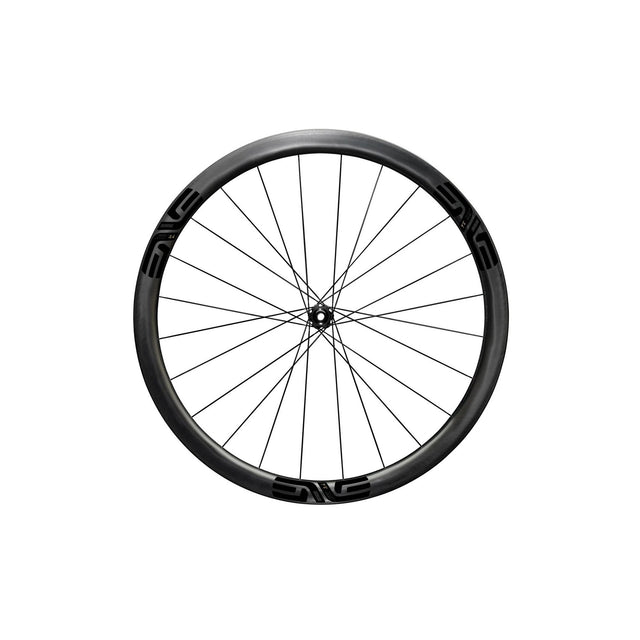
ENVE SES 3.4 Disc Wheel - Front
-
 RA price match promise
-
Pay later with
,
and
Prices subject to change. How pricing works →
Pickup available at RA Cycles - Brooklyn
Normalmente pronto em 24 horas
Questions about this product?
Questions about this product?

ENVE SES 3.4 Disc Wheel - Front
ENVE SES 3.4 Disc Wheel - Front Info
The ENVE SES 3.4 Disc Wheel - Front is the front half of what ENVE positions as the most versatile wheel in its SES lineup, sitting between the shallower SES 2.3 and the deeper, more aero-focused SES 4.5. Rather than optimizing purely for one discipline, the SES 3.4 is built to hold up on the Dolomite climbs of the Giro d'Italia, the gravel sectors of an event like Unbound, and a flat-out sprint on a Saturday group ride, all with the same wheel. This listing is the front wheel only, built at a 38mm rim depth and meant to be run alongside ENVE's 42mm-deep SES 3.4 rear wheel as a matched system rather than an identical pair. The current SES 3.4 generation combines what ENVE learned from the previous 3.4 and 3.4 AR models into what it calls its most well-rounded road wheel to date.
Front and Rear System Design
That mismatched depth between front and rear is deliberate. ENVE builds unique rim shapes for the front and rear positions on its SES wheels because the two wheels do different jobs in a crosswind. A shallower front rim stays more predictable when a gust hits, since it's the wheel steering the bike, while the deeper rear wheel sits in the front wheel's aerodynamic wake and can recapture airflow for a real efficiency gain without the same handling penalty. Together, the front-and-rear SES 3.4 pair weighs about 1,390 grams as a full wheelset, a meaningful weight reduction from the previous generation thanks to an updated carbon laminate, without giving up the depth and volume that make the wheel confident on rough pavement or a technical descent.
Wide Hookless Bead and Tubeless Performance
The rim carries a 25mm internal width and ENVE's patent-pending Wide Hookless Bead, a design at the leading edge of the rim engineered to reduce the odds of a pinch flat on tubeless tires when the rim takes an impact. The hookless design also lets ENVE machine the bead seat diameter to the precise tolerance defined by ETRTO, which is what gives a tubeless tire consistent, reliable fitment and strong air retention around the entire rim rather than just in spots. That combination of high internal volume and a well-sealed tubeless setup is a big part of why the SES 3.4 has become a common choice for mixed-surface riding, not just pure road use, since it supports the wider, lower-pressure tires that terrain calls for, all while ENVE still optimizes the aero shaping specifically around those higher-volume tubeless tires rather than the narrower tubes-and-tires setups of a decade ago.
Real-World Fast Design and Versatility
ENVE develops its aero wheels under what it calls a Real-World Fast approach, testing at realistic road speeds like 20 and 30 mph rather than a single wind tunnel benchmark, and weighting drag data toward the wind angles riders actually spend most of their time in, since anemometer data shows most real-world riding happens at less than 12 degrees of yaw. That testing philosophy is part of why the SES 3.4 has been raced at the World Tour level while also earning a following among gravel racers who need a wheel that can hold up off pavement. Professional cyclist Alexey Vermeulen has described the SES 3.4 as a "quiver killer," saying it moves between 28mm road tires and 40mm gravel tires on the same wheelset without giving up performance in either setup, which is a fairly rare claim for a wheel this shallow to be able to make credibly.
Hub and Who It's For
Both the front and rear SES 3.4 wheels use ENVE's INNERDRIVE Premium Road Hub, the same hub found across the rest of the SES and G-Series lineup. It's built with oversized steel ratchets for reliable engagement and reduced stress on the axle, and it's roughly 60 grams lighter than the hub it replaced, while still holding to consistent spoke lengths through an anti-twist spoke design that keeps the wheel building process, and any future rebuild, more straightforward. Buying the front wheel on its own makes sense for a rider replacing a damaged front wheel, building a custom front-and-rear pairing, or running the front on a second bike while sharing a rear wheel between setups. For a rider who wants one wheelset capable of road racing, gravel, and everything between, the SES 3.4 front is the shallower, crosswind-stable half of that system, built to be run with its deeper rear counterpart rather than as a standalone matched pair.
The RA Perspective
ENVE SES 3.4 Disc Wheel - Front Video