

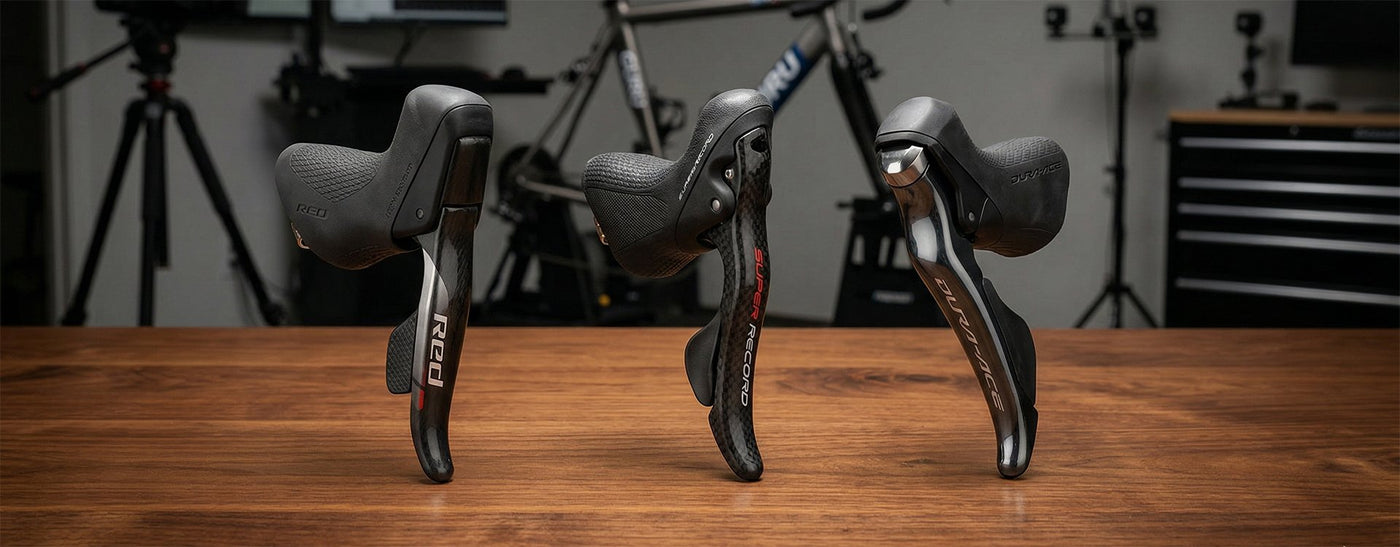
If the frame is the body of your bike, the groupset is the nervous system. It listens to your hands, responds to your intentions, and when it works well, disappears entirely. You stop thinking about your drivetrain and start thinking about the ride.
That disappearing act is exactly what electronic shifting does better than anything else. No cable stretch. No seasonal adjustments drifting your indexing out of spec. No gradual decline from perfect to almost-perfect to finally-needs-a-tune. Electronic shifting stays where you set it, ride after ride, season after season.
Today, three companies define the electronic shifting landscape: Shimano with Di2, SRAM with AXS, and Campagnolo with their wireless systems. Each brings a distinct philosophy and feel to the experience, and understanding those differences is the key to choosing the right system for your riding.
This guide breaks down every current electronic groupset across road and gravel, compares them honestly, and helps you decide where to put your money.

Why Electronic Shifting Is Winning
Mechanical shifting still has its loyalists, and for good reason. There is a tactile satisfaction to a perfectly tuned cable-actuated drivetrain. It is simpler to understand, usually less expensive, and requires no charging or firmware updates.
But mechanical has one unavoidable weakness: cables age. Housing gets contaminated. Spring tension changes. Your shifting slowly drifts away from perfection, especially in wet weather or after high-mileage months. The maintenance cycle is constant.
Electronic shifting eliminates that drift. Motors move the derailleur to a precise, programmed position every time. Rain, mud, dust, neglect — none of it affects shift accuracy the way it degrades cable systems. That consistency is why professional racing went electronic years ago and why the rest of the market is following.
There are practical benefits beyond consistency too. Electronic systems allow customizable shift logic — sequential shifting, synchronized modes, and programmable button mapping. Most systems now integrate with cycling computers and offer firmware updates that genuinely improve performance over time.
If you currently ride mechanical and it works for you, there is no urgency to switch. But if you are building a new bike or upgrading, electronic is the direction the industry has committed to. Parts availability and development resources are increasingly concentrated here.

Three Brands, Three Personalities
Choosing between Shimano, SRAM, and Campagnolo is not just about specifications. Each system has a distinct character that appeals to different riders.
Shimano Di2 is precision engineering. It tends to feel the most polished and refined of the three, with shift actions that are quiet, controlled, and predictable. Shimano moves carefully — they are rarely first to market with a new idea, but when they commit, the execution is thorough. Di2 uses a semi-wireless architecture: wireless communication between shifters and derailleurs, but a small internal battery with wired charging. The system supports both synchronized and manual shifting modes, and the E-Tube app gives you granular control over shift speed and button assignment.
SRAM AXS is fast, modern, and modular. Their system is fully wireless — no wires anywhere, with individual coin-cell batteries on each derailleur. That makes installation and bike swaps remarkably simple. The AXS app ecosystem connects shifting, power meters, tire pressure sensors, and more into one interface. SRAM also pioneered the wide-range 1x drivetrain for gravel and offers the broadest cross-compatibility between road and off-road components. If you like the idea of a connected, easily configurable system, SRAM delivers that better than anyone.
Campagnolo Wireless is passion made mechanical. The Italian company has been building groupsets since 1933, and their latest 13-speed wireless systems are the most technically ambitious work they have ever done. Campagnolo is the only manufacturer offering 13 speeds, giving you finer gear steps across the cassette range. The ergonomics are distinctive — the thumb shifter on the inside of the hood is a Campagnolo signature that riders either love immediately or need time to appreciate. The latest Super Record 13 brought significant weight reductions and faster shifting, while also lowering the price closer to Shimano and SRAM territory.

Road Groupsets: The Full Electronic Lineup
Shimano Road: Dura-Ace Di2 vs Ultegra Di2 vs 105 Di2
Shimano offers three tiers of electronic road groupsets, all sharing the same 12-speed architecture and semi-wireless platform.
Dura-Ace Di2 R9250 is the flagship. The rear derailleur weighs 215 grams with a carbon cage, and Shimano claims it shifts 58 percent faster than the previous generation. Front derailleur weight is 99 grams. Every component is optimized for minimum weight and maximum refinement. This is the groupset for riders building a no-compromise race bike where every gram and every millisecond of shift response matters.
Ultegra Di2 R8150 shares the same shift logic, motor technology, and 12-speed cassette range as Dura-Ace. The differences are materials and finishing — slightly heavier components made from less exotic alloys. In blind shifting tests, most riders cannot distinguish Ultegra from Dura-Ace. For the vast majority of serious riders, Ultegra Di2 is the sweet spot: near-flagship performance at a meaningfully lower price.
105 Di2 R7150 brought electronic shifting to a broader audience. It uses the same wireless platform and shift quality as its more expensive siblings, with the tradeoff being additional weight. If you want the consistency and convenience of electronic shifting without the premium price, 105 Di2 is the entry point — and it is a genuinely excellent one.
SRAM Road: RED AXS vs Force AXS vs Rival AXS
SRAM's road lineup follows the same three-tier structure, all built on the fully wireless AXS platform with E1 generation components.
RED AXS E1 is the lightest electronic groupset available, with a complete group weight around 2,566 grams including power meter. The crankset and chainrings received the biggest weight savings in the E1 update. Cassette options span from 10-28T to 10-36T, all machined from single-piece steel using SRAM's X-Dome construction. RED is for riders who want the absolute lightest, most refined wireless experience.
Force AXS E1 is the performance sweet spot in the SRAM lineup. It shares the same wireless shifting platform and AXS app integration as RED, with slightly heavier components at a lower price. Force is the groupset most commonly spec'd on high-end builds because it delivers the core SRAM experience — fast wireless shifts, excellent ergonomics, broad compatibility — without the flagship premium.
Rival AXS E1 is the value entry into fully wireless electronic shifting. Heavier than Force, but functionally identical in terms of shift quality and wireless reliability. For riders building a capable road or gravel bike on a budget, Rival AXS proves that wireless electronic does not have to mean expensive.
Campagnolo Road: Super Record Wireless
Campagnolo takes a different approach to their road lineup. Rather than offering three tiers of electronic, they concentrate their technology into the Super Record level.
Super Record 13 Wireless is the world's first 2x13-speed groupset. The extra sprocket gives you finer gear steps — particularly useful on long climbs where a single tooth difference in the cassette can mean the difference between grinding and spinning comfortably. Claimed group weight is 2,445 grams, making it competitive with Shimano Dura-Ace. The rear derailleur fires from smallest to largest cog in 2.1 seconds and back in 1.9 seconds, representing roughly 40 percent faster shifting than the previous generation.
The ergonomic design is uniquely Campagnolo. The thumb shifter sits on the inside of the hood, and the shift paddles have a feel and travel that is distinctly different from Shimano or SRAM. It is not better or worse — it is different, and for many riders, it is the difference that makes Campagnolo special.
At a retail price that now sits closer to Shimano Dura-Ace and SRAM RED, Super Record 13 is more accessible than previous Campagnolo flagships. If you value craftsmanship, the riding heritage of Italian manufacturing, and genuinely distinctive ergonomics, this is the groupset that delivers something the other two simply do not attempt.

Gravel Groupsets: Where 1x Changes the Conversation
Gravel riding changed the rules for drivetrains. On the road, 2x dominates because tight gear steps help you hold the perfect cadence in a paceline or on sustained climbs. On gravel, simplicity matters more. Mud, vibration, impacts, and unpredictable terrain punish complexity.
That is why 1x has become the default gravel drivetrain. Fewer parts, fewer problems, and a chain that stays quiet and stable when the ride gets rough. If you primarily ride gravel with occasional road use, 1x is worth serious consideration. If you split time between road group rides and gravel adventures, 2x gives you the gear range and fine steps that road riding rewards.
Shimano GRX Di2 RX827
Shimano's gravel-specific electronic groupset uses the same Di2 wireless platform as their road groups but with gravel-focused refinements — wider gear range, clutch-equipped rear derailleur for chain stability, and ergonomics designed for riding on the hoods over rough terrain. GRX Di2 is the choice for riders who want Shimano's refined shifting feel in a gravel-ready package.
SRAM XPLR AXS: RED vs Force vs Rival
SRAM's XPLR line is the broadest gravel-specific electronic offering available. All three tiers — RED, Force, and Rival — are fully wireless and designed around 1x drivetrains with wide-range cassettes that handle everything from road-speed descents to steep fire road climbs.
Force XPLR AXS E1 hits the sweet spot for most gravel riders: modern wireless shifting, excellent durability, race-capable performance, and a price that does not require justification. RED XPLR saves weight for competitive gravel racers. Rival XPLR opens the door for riders building their first serious gravel machine.
Campagnolo Gravel: Super Record X Wireless
Campagnolo has announced gravel-specific versions of their 13-speed wireless platform, including a clutch-equipped rear derailleur and both 1x13 and 2x13 configurations. This expands Campagnolo's reach beyond pure road racing for the first time with electronic shifting. Availability is expected to follow the road groupset rollout.
2x vs 1x: Choosing the Right Crankset Setup
This decision affects every ride, so it deserves careful thought rather than following trends.
2x is about precision. You get smaller jumps between gears, making it easier to hold your preferred cadence exactly where you want it. That matters on the road, where a two-tooth jump at the wrong moment can push you out of your rhythm in a paceline. For road riding, road racing, big climbs followed by fast descents, and group ride situations where cadence control is critical, 2x remains the better choice.
1x is about simplicity. Removing the front derailleur eliminates one shifting decision, one cable or wireless connection, and one potential mechanical issue. On gravel, that simplicity is a genuine advantage — less to adjust, less to go wrong, and better chain retention when the bike is bouncing over rough surfaces.
The future holds both. For gravel, 1x is clearly the dominant direction. For road, 2x still makes the most sense for the majority of riders. And with cassette ranges expanding across all three brands, the gear range gap between 1x and 2x continues to narrow.
What Actually Matters When Selecting a Groupset
When riders shop for groupsets, they often get stuck on price tiers and hierarchy. A more productive framework is to ask: what will make my rides smoother, calmer, and more enjoyable?
The factors that matter most are shifting consistency, braking confidence, gearing that matches your terrain, and long-term parts availability. Higher-tier groupsets deliver lower weight, nicer materials, and a more refined feel — but the functional difference between tiers within a brand is often smaller than riders expect. A well-set-up Ultegra Di2 bike and a Dura-Ace Di2 bike will shift and brake almost identically on a Tuesday morning group ride.
Where budget allows, investing in the mid-tier of whichever brand you prefer — Ultegra Di2, Force AXS, or Super Record if you are a Campagnolo rider — typically delivers the best balance of performance and value. If budget is tighter, 105 Di2 and Rival AXS are genuinely excellent groupsets that will serve you well for years.
And if you are agonizing over the last few grams or the most premium finish, Dura-Ace Di2, RED AXS, and Super Record 13 all represent the pinnacle of their respective brand's engineering.
Beyond the Groupset: Upgrades That Change Your Riding
A groupset is a significant investment, but three other areas often change your riding experience more than any derailleur ever will.
A professional bike fit ensures your body and bike work together efficiently. Comfort, power output, and handling all live in the fit. If you have not been professionally fit, that should be your first investment.
Wheels and tires have a dramatic effect on how your bike feels. Wheels change acceleration, stability, and speed maintenance. Tires change comfort, grip, and rolling efficiency. A wheel and tire upgrade on a mid-range groupset bike will often feel more transformative than a groupset upgrade alone.
A power meter turns your training from guesswork into data. If you train with purpose or race, a power meter helps you pace efforts, avoid blowing up early, and track fitness over time. SRAM integrates power measurement into their cranksets across all tiers, and Favero offers excellent pedal-based options that work with any groupset.
Final Thought
Groupsets do not make you dramatically faster. They make riding less annoying. They make the bike smoother, quieter, and more consistent — and that consistency means you ride more, enjoy it more, and stay focused on what actually matters: the ride itself.
Electronic shifting is not a luxury anymore. It is the direction every manufacturer is investing in, and the benefits — consistent performance, lower maintenance, smarter integration — are real. Whether you choose Shimano's refined precision, SRAM's wireless modularity, or Campagnolo's distinctive Italian character, you are getting a system that will serve you well for thousands of miles.
The best groupset is the one that matches your riding, fits your budget, and comes from a brand whose philosophy resonates with you. At RA Cycles, we carry all three ecosystems and we have built bikes with every tier. If you want help deciding, that is exactly the kind of conversation we love having.
