

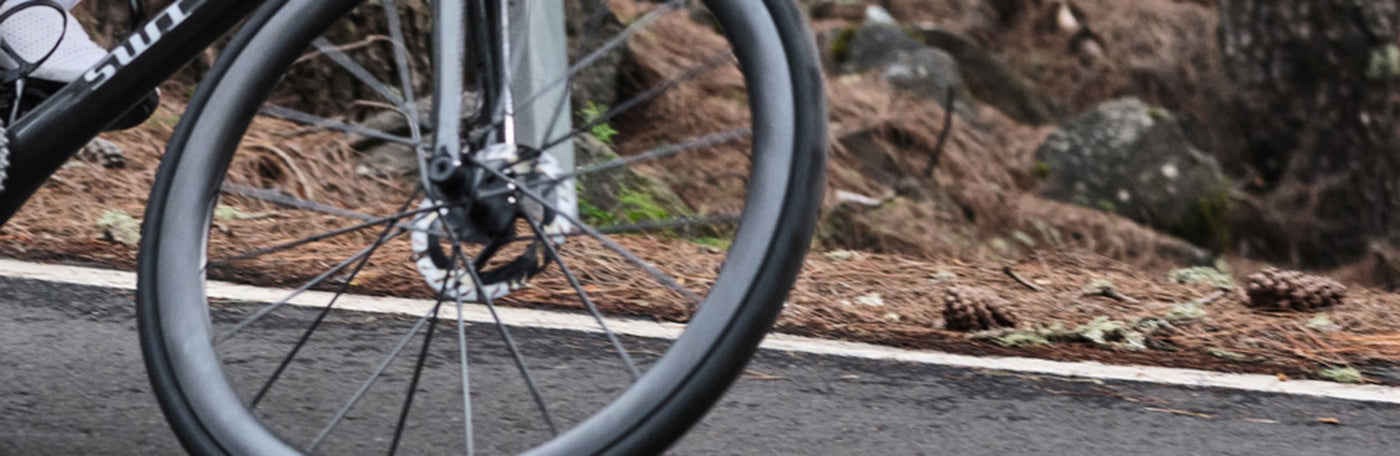
Most cyclists spend more time choosing frames and wheels than they do thinking about tires. That's a mistake. The tire is the only contact point between you and the road, and it has more effect on speed, comfort, and handling than almost anything else on the bike. Swap the right rubber onto a modest wheelset and you'll outperform someone on far more expensive wheels with the wrong tire.
What follows is our breakdown of tire type, width, compounds, pressure, setup, and which tires we stock at RA Cycles suit which riders.

Clincher, tubeless ready, and tubular: which type?
In 2026, tubeless ready (TR) is the right choice for almost every road cyclist.
Traditional clincher tires use a separate inner tube. Still reliable, and a tube is still the roadside backup when tubeless fails. The limitation: tubes add weight and rotational inertia, and they're vulnerable to pinch flats when you hit a sharp edge under pressure.
Tubeless ready (TR) tires seal directly against a compatible rim without a tube. The interior fills with liquid sealant that plugs small punctures automatically. Lower optimal pressure rolls faster on imperfect roads, not slower. Virtually every high-performance road tire sold today is tubeless ready.
Tubular tires are stitched and glued to dedicated tubular rims. Still used at the highest level of professional racing for specific conditions, but not practical for most riders. The setup is involved and a roadside repair is genuinely hard.
The case for tubeless comes down to this: sealant handles most punctures on the spot, lower pressure reduces rolling resistance on real roads, and the ride feels noticeably more supple. Setup takes more care the first time. After that it's less hassle than clinchers, not more.

Tire width: the 25-32mm reality
The idea that narrower tires are faster was disproved by rolling resistance testing over a decade ago. The whole WorldTour peloton moved to 28-30mm and hasn't gone back.
A wider tire at the same pressure creates a shorter, broader contact patch. That patch flexes less with each revolution, meaning less energy gets absorbed by the casing. Lower rolling resistance, not higher — the opposite of what most riders assumed for years.
25mm: Still works for riders who prioritize low weight and ride mainly on smooth, well-maintained roads. Higher pressure, more direct feel, less compliance.
28mm: Where most riders should start. Fast, comfortable on long days, fits every modern road frame. WorldTour standard for a reason.
30mm: Worth considering if your roads are rough or you're on an endurance frame. The speed difference versus 28mm is marginal on anything but perfect tarmac.
32mm: The choice for mixed surfaces, rougher roads, or endurance and all-road bikes. Pairs well with hookless rims and gives the most compliance of the four.
Before you decide: check your frame's actual tire clearance. Most modern road frames clear 28-30mm without trouble; many clear 32mm. Actual inflated width typically runs 1-2mm wider than the labeled size, depending on your rim's internal width.

Tread, casing, and compound: what the numbers mean
TPI (Threads Per Inch) is the number of threads in the casing fabric. Higher TPI means a more supple, lighter, faster-rolling casing and a more expensive tire. Race tires run 120-320 TPI. The Vittoria Corsa Pro uses 320 TPI Corespun-K cotton casing. The Vittoria Corsa N.EXT uses 100 TPI nylon for durability. Training tires typically use 60-90 TPI.
The rubber compound is what determines grip, rolling resistance, and how long the tire lasts. The brands we carry use different approaches:
Graphene + Silica G2.0 (Vittoria): Graphene molecules dispersed in the rubber. Vittoria claims improved grip, lower rolling resistance, and better durability versus traditional silica compounds. G2.0 is the second-generation formulation.
SmartEVO and SmartEVO² (Pirelli): Pirelli's motorsport-derived compound family. SmartEVO² — used on the P Zero Race TLR RS and SL-R — adds wet grip and cornering confidence. The standard SmartEVO is on the P Zero Race and P Zero Race SL.
SMARTNET Silica (Pirelli): More silica for all-conditions grip, used on the Cinturato Evo and P Zero Race TLR 4S. Wet grip over peak rolling efficiency.
Black Chili (Continental): Continental's high-performance compound across the Grand Prix line. It rolls efficiently and holds up well.
On tread pattern: road tire grooves don't pump water away from the contact patch the way car tires do. The contact patch pushes water out through pressure. A smooth or lightly textured tread rolls faster. For year-round conditions, compound matters far more than tread pattern.

Tire pressure: the modern approach
High pressure was road cycling gospel for a long time. It was wrong. Rolling resistance data showed that lower pressure on wider tires reduces rolling resistance, and the whole sport has adjusted.
Optimal pressure is where the tire deforms just enough to absorb road surface variation without the sidewall flexing too much. Too high and the tire skips over rough patches instead of absorbing them, which costs speed and grip. Too low and the casing flexes too much, sealant can burp out, and handling gets squirrelly.
Two things determine where you should land: rider weight and tire width. The table below is a starting point for tubeless on hooked rims, based on combined rider-plus-bike weight. Run the front 3-5 PSI below the rear.
| Tire Width | Under 145 lbs | 145-175 lbs | 175-200 lbs | 200+ lbs |
|---|---|---|---|---|
| 25mm | 88-98 PSI | 95-105 PSI | 100-112 PSI | 108-118 PSI |
| 28mm | 72-82 PSI | 78-88 PSI | 84-94 PSI | 90-100 PSI |
| 30mm | 62-72 PSI | 68-78 PSI | 74-84 PSI | 80-90 PSI |
| 32mm | 55-65 PSI | 60-70 PSI | 66-76 PSI | 72-82 PSI |
One thing worth knowing: if your wheels are hookless (common on modern carbon aero disc wheels), the ETRTO standard caps all tubeless tires at 73 PSI / 5 bar regardless of width or what the sidewall says. Don't go over that.
Surface adjustment: rough or chip-seal roads, drop 5-8 PSI. Very smooth tarmac, add a few. Tubeless tires typically lose 3-5 PSI overnight through casing permeability. That's normal.
Tubeless setup: getting it right
Tubeless setup is one of those things that looks more complicated than it is. Once you've done it, it takes about 20 minutes.
What you need: a tubeless-ready tire, a tubeless-compatible rim with rim tape applied, a tubeless valve, about 30ml of liquid sealant per tire, and a floor pump. A tubeless blast inflator makes seating the bead much easier on the first mount.
Step 1: Apply rim tape tightly across the full rim bed, overlapping the start by 2-3cm and pressing firmly over the spoke holes. Most tubeless problems start here. Bad tape means slow leaks you'll spend an hour trying to find.
Step 2: Install the tubeless valve. Finger-tight plus a quarter turn on the locknut. Over-tightening can crack carbon rims.
Step 3: Mount one side of the bead fully. Add 30ml of sealant, either through the valve (remove the core with a valve core tool) or by pouring directly in before mounting the second bead.
Step 4: Mount the second bead and seat it with a blast of air. Spin and tip the wheel to spread sealant evenly around the inside.
Step 5: Pump to target pressure. Minor seepage through small imperfections usually seals in the first few minutes of riding. Shake and rotate the wheel before heading out.
Maintenance: sealant dries over 2-6 months. Shake the wheel — if you hear liquid, you're fine. If not, add 15-20ml through the valve. A full re-tape and fresh sealant once a season keeps the system working properly.
On the road: sealant handles most punctures automatically. For cuts the sealant can't seal — typically anything over 4mm — tire plugs are the next step. We recommend Dynaplug plugs: compact, fast to use, and they hold pressure long enough to finish a ride. Every rider should carry a Plugger, a CO2, and a spare tube as the last resort. For the tube, use a TPU tube — lighter and smaller than a standard butyl, easy to fold into a jersey pocket.
The tires we carry at RA Cycles
Here's how to match the tires we stock to how you ride.
Race and maximum performance
Light casing, low rolling resistance, dry conditions. If you're racing or riding hard in a fast group, this is the category.
Vittoria Corsa Pro Speed G2.0 Tubeless
Vittoria's speed-focused version of the Corsa Pro. The 320 TPI Corespun-K cotton casing and Graphene + Silica G2.0 compound are tuned for one thing: rolling resistance. Only comes in 28c and 30c, which covers most road racing setups. The fastest-rolling Vittoria we carry.
Continental Grand Prix 5000S TR
The benchmark for performance road tires. The GP 5000S TR is consistently near the top in independent rolling resistance tests, works on hooked and hookless rims (73 PSI max on hookless), and comes in 25, 28, 30, and 32mm. Most other road tires are measured against this one.
Pirelli P Zero Race SL-R TLR
Pirelli's top road tire. The SL-R is the fastest and most aerodynamic in the P Zero Race line, built with WorldTour input using SmartEVO compound and TechWALL construction. Available in 28c and 30c. This is Pirelli at its peak.
Pirelli P Zero Race SL Tubeless
The lightweight Pirelli race tire with a slick tread and SmartEVO compound. Available in 25c and 28c, which makes it the Pirelli option for riders with tighter frame clearances or who want the narrower width.
All-round performance
Fast enough to race on, tough enough to train on. Most riders who want one tire for everything are shopping here.
Vittoria Corsa Pro G2.0 Tubeless
The all-round Corsa Pro. Same Graphene + Silica G2.0 compound and cotton casing as the Speed, but built to work across a wider range of conditions. Available in 25c, 28c, and 30c.
Pirelli P Zero Race TLR RS
The latest P Zero Race with the updated SmartEVO² compound. Better grip and cornering in both wet and dry conditions compared to the previous generation. Made in Italy. Available in 28c and 30c. A strong tire at this price.
Pirelli P Zero Race Tubeless
The original P Zero Race tubeless. It's been raced at WorldTour level for years, uses the SmartEVO compound, and comes in 25c, 28c, and 30c. Straightforward, proven, and a bit less expensive than the RS.
Continental Grand Prix TR
Continental's all-purpose tubeless tire. More durable than the 5000S TR and costs less. Good for riders who want Grand Prix performance without managing separate race and training tire sets. Available in 25c, 28c, and 32c.
All-season and wet-weather
For year-round riding and wet roads, where grip matters more than a few extra watts.
Pirelli P Zero Race TLR 4S
Pirelli's year-round race tire. The 4S uses the SMARTNET Silica compound for wet grip and puncture protection while keeping the P Zero Race shape and feel. If you race or ride hard through winter, this is the one.
Continental Grand Prix 5000 All Season TR
The all-season version of the GP 5000 line. The compound is tuned for wet roads, giving noticeably better grip than the standard 5000S TR when conditions are damp. Available in 28c and 32c. Bay Area riders who push through winter should know this tire.
Pirelli Cinturato Evo TLR
Pirelli's endurance and all-road tire. The Cinturato Evo uses the SmartEVO AS compound with over 50% bio-based materials and FSC-certified natural rubber. It runs from 28c to 55c, covering road, gravel, and everything between. If you want one tire for all of it, this is a reasonable answer.
Everyday training and high durability
These tires are built to take punishment. You give up some speed, but they'll get through heavy training miles, bad roads, and all the conditions you'd rather not put race tires through.
Pirelli P Zero Road TLR
The training version of the P Zero. Tubeless-ready, built for durability over speed. Available in 28c and 32c. Putting these on training wheels while keeping race tires for race day is a sensible setup a lot of riders use.
Vittoria Corsa N.EXT G2.0 Tubeless
The Corsa N.EXT swaps cotton for a 100 TPI nylon casing, which holds up better under daily training loads. You still get the Graphene + Silica Race Formulation compound, so it's fast enough for hard workouts while lasting much longer than the cotton-cased options. Runs from 24c to 34c.
Vittoria RideArmor Tubeless
Vittoria's most durable road tubeless tire. Multiple reinforced layers over the full casing. Not the fastest thing on this list, but it'll survive roads and training loads that would wreck a race tire. If you've had enough flats, this is the tire.
Which tire is right for you?
Most riders land on 28mm and don't look back. The Vittoria Corsa Pro G2.0 and Pirelli P Zero Race TLR RS handle racing, hard training, and everyday riding without much fuss.
For the fastest days, the Continental GP 5000S TR and Vittoria Corsa Pro Speed G2.0 are where to look.
Riding through wet winters? The Continental GP 5000 All Season TR and Pirelli P Zero Race TLR 4S are built for that.
High training volume and you've gone through too many tires? The Vittoria Corsa N.EXT G2.0 — nylon casing, Corsa compound, lasts.
All of these are in stock at RA Cycles. If you're not sure where to start, come in, call, or write — we're happy to narrow it down. Browse the full range at racycles.com/collections/bike-tires, or shop by brand: Pirelli, Continental, Vittoria.
Pricing note: Prices listed in this guide were accurate at time of writing and are subject to change. For current pricing, visit racycles.com or contact us directly.
